


Public Law Update – SB 79 Explained: How California’s Newest Housing Law Changes the Rules Around Transit-Oriented Development
Jan 12, 2026SB 79, authored by Senator Scott Wiener, has been signed into law, enacting a sweeping new framework for residential development near major transit. The law does not go into effect until July 1, 2026 (unincorporated county areas have until the start of the 7th Regional Housing Needs Allocation, or “RHNA” cycle), but already reflects California’s ongoing shift toward state-led housing reform.
Applicability
SB 79 applies to “urban transit counties,” meaning counties with 15 or more passenger rail stations. Currently, only Alameda, Los Angeles, Orange (2026), Sacramento, San Diego, San Francisco, San Mateo, and Santa Clara Counties qualify.
The law identifies a transit-oriented development (“TOD”) zone as most sites within a half-mile of a TOD stop. TOD stops include any major transit stop (as defined by Section 21064.3 of the Public Resources Code) as well as stops identified in a regional transportation improvement plan, and stops served by heavy rail transit, very high frequency commuter rail, high frequency commuter rail, light rail transit, or bus service within an urban transit county. TOD stops are categorized into Tier 1 and Tier 2 based on the frequency and type of transit service. Tier 1 stops include heavy rail and very high-frequency commuter rail, while Tier 2 stops include light rail, high-frequency commuter rail, and certain high-frequency bus routes.
SB 79 establishes eligibility for housing development projects within one-half mile or one quarter mile of TOD stops on residential, mixed-use, or commercially-zoned sites. Projects must include at least five dwelling units and meet a minimum density of at least 30 dwelling units per acre, or the minimum density required under local zoning, whichever is greater. Projects may not include hotels or similar uses.
The average total area of floor space for proposed SB 79 units may not exceed 1,750 “net habitable square feet,” defined as the finished and heated floor area fully enclosed by the inside surface of walls, windows, doors, and partitions, and having headroom of at least 6 ½ feet. Net habitable square feet includes working, living, eating, cooking, sleeping, stair, hall, service, and storage areas, but excludes garages, carports, parking spaces, cellars, half-stories, and unfinished attics and basements.
Density, Height Allowed
Local governments must allow for the following:
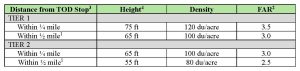
1 Within a city with a population of at least 35,000 people.
2 The minimum FAR includes other local development standard or combination of standards that would physically preclude achieving a residential FAR of “up to” the minimum FAR stated. This means other standards that may affect maximum residential FAR (e.g., setbacks, stepbacks, open space requirements), may be limited as well.
3 For projects immediately adjacent to a transit stop, an “adjacency intensifier” allows an additional 20 feet of height, 40 extra units per acre, and a 1.0 FAR increase, prior to any density bonus.
4 All SB 79 projects over 85 feet must use a “skilled and trained” workforce, as defined in state law.
____________
SB 79-eligible projects can qualify for streamlined approval under SB 35/423, as well as additional density, incentives and concessions, and waivers from development standards under State Density Bonus Law (Gov. Code § 65915 et seq.). In addition, certain SB 79 projects may also receive:
- 3 additional incentives or concessions if the project includes housing for extremely low income households.
- 2 additional incentives or concessions if the project includes housing for very low income households.
- 1 additional incentive or concession if the project includes housing for low income households.
Affordability.
SB 79 projects that have more than 10 units must set aside:
- 7% of units as extremely low-income housing, defined as 30% or less of the area median income (AMI); or
- 10% of units as very low-income housing, defined as 30 to 50% of the AMI; or
- 13% of units as low-income housing, defined as 50 to 80% of the AMI.
SB 79 projects must also adhere to local inclusionary zoning requirements.
Alternative Compliance
Local jurisdictions in a TOD zone do not need to adopt a local ordinance implementing SB 79. However, they have the option of adopting a “transit-oriented development alternative plan” (“TOD Alternative Plan”) that modifies the default development allowed under SB 79. A TOD Alternative Plan allows cities to exercise some amount of local control over how SB 79 is implemented, but must satisfy all of the following:
1. The Plan must maintain at least the same total “net zoned capacity,” in terms of both total units and residential floor area allowed by SB 79, across all TOD zones within the jurisdiction.
2. The Plan may not reduce the maximum allowed density for any individual site by more than 50 percent below what SB 79 permits, except for sites meeting any of the following criteria:
A. Sites within a very high fire hazard severity zone
B. Sites that are vulnerable to one foot of sea level rise
C. Sites with a historic resource designated on a local register, so long as such sites do not exceed 10 percent of the eligible area of any TOD zone.
D. Sites within one-half mile of a Tier 2 TOD stop must have a minimum density of 30 du/acre with a residential floor area ratio of 1.0 (except for sites specified in subparagraphs (A) to (C)), and should be considered for attached entry level owner occupied housing development opportunities.
3. The Plan may not reduce the capacity in any TOD zone in total units or residential floor area by more than 50 percent.
In other words, a local jurisdiction must allow for the same total development capacity permitted by default under SB 79, but can reallocate where units are located. Any TOD Alternative Plan must be reviewed and certified by the Department of Housing and Community Development (HCD).
Next Steps.
As jurisdictions prepare for implementation, legal counsel and planning staff should review affected zoning districts, evaluate options for local compliance, and assess whether to adopt an alternative TOD plan. SB 79 is expected to have broad implications for land use planning, entitlement processes, and long-term housing production across California’s transit-rich regions.
Burke, Williams & Sorensen, LLP regularly advises clients on legal matters relating to housing, and land use issues.
All materials have been prepared for general information purposes only to permit you to learn more about our firm, our services and the experience of our attorneys. The information presented is not legal advice, is not to be acted on as such, may not be current and is subject to change without notice
