

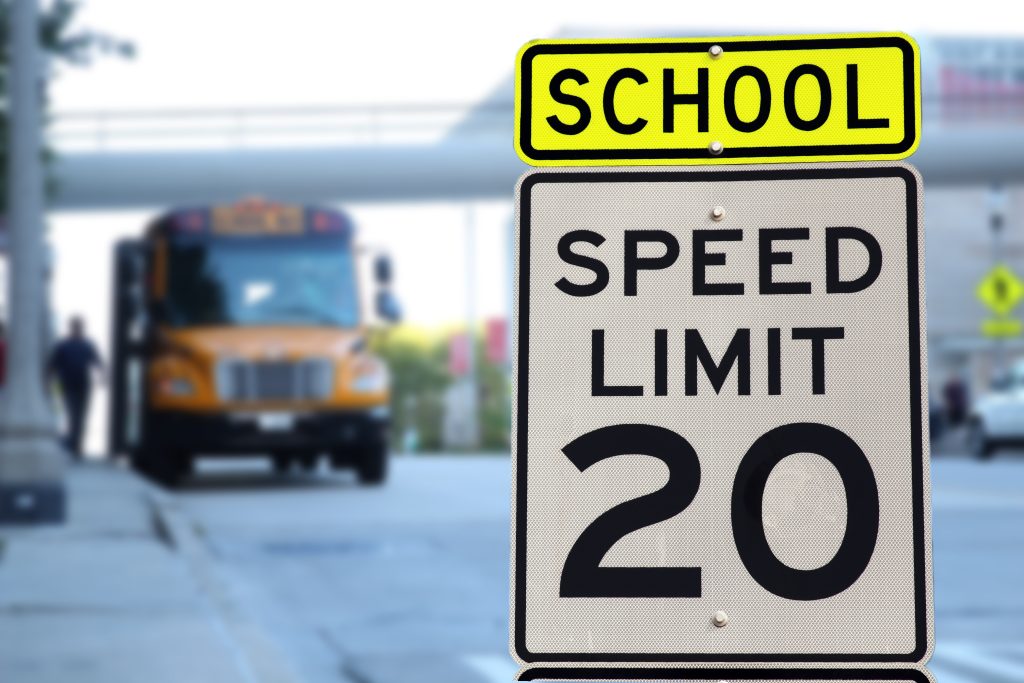
Public Law Update – AB 382: Statewide 20 Miles Per Hour School Zones and Local Options
Jan 28, 2026Summary and Context
Assembly Bill (AB) 382 updates how California sets and enforces speed limits near schools. The bill lowers the baseline school zone speed limit from 25 miles per hour to 20 miles per hour, standardizes what counts as a “school zone” and when “children are present,” and aligns related rules governing local authority.[1]
Beginning January 1, 2031, the 20 miles per hour standard applies statewide in posted school zones whenever school zone signs indicate the lower limit is in effect. Before that date, cities and counties may adopt 20 miles per hour school zone limits under temporary authority if they choose to do so.[2]
AB 382 also preserves existing tools that allow local agencies to post 15 miles per hour limits on certain residential streets within school zones and 25 miles per hour limits on defined approach segments, subject to statutory conditions. The bill uses a single, consistent definition of “school zone” across speed limit and enforcement provisions.[3] Properly posted school zone speed limits may continue to be enforced using radar without a current engineering and traffic survey, consistent with long-standing school zone enforcement rules.
Background
The Legislature adopted these changes in response to ongoing concerns about child pedestrian safety and research showing that lower vehicle speeds reduce both the likelihood and severity of crashes near schools. Legislative analyses for AB 382 reference national recommendations for 20 miles per hour school zones and California-specific collision data in school areas. [4]
New 20 Miles Per Hour School Zone Framework
Beginning January 1, 2031, the default rule for posted school zones statewide changes. When a road is signed as a school zone and the conditions shown on school signs are met, the prima facie speed limit is 20 miles per hour instead of 25 miles per hour. Put simply, when school signs indicate the lower limit applies, drivers are expected to slow to 20 miles per hour.[5]
The statute allows three familiar ways to show that the 20 miles per hour limit is in effect. One option is a sign with flashing beacons stating “SPEED LIMIT 20 WHEN FLASHING,” which applies when the lights are flashing. Another is a sign stating “CHILDREN ARE PRESENT,” which applies when children are actually present under the statutory definition. A third option allows a sign to list specific hours, selected by the local agency, during which the 20 miles per hour limit applies. In each case, the reduced speed applies only when the condition shown on the sign is met.[6]
At the same time, AB 382 preserves the familiar 25 miles per hour rules for business districts, residential areas, and senior zones. Those provisions continue to operate as before and are now grouped together in a separate subdivision, with the new school zone rules addressed alongside them rather than replacing them.[7]
What Counts as a “School Zone” and When Children Are “Present”
AB 382 standardizes key definitions used throughout the Vehicle Code.
A “school zone” is defined as the area of a highway within 500 feet of school grounds in any direction, so long as it is marked with appropriate school warning signs. This treats the area around a school as a defined zone, rather than focusing only on the street immediately adjacent to the campus.[8]
The statute also clarifies when children are present. Children are present when they are going to or leaving school, or when school grounds are in use by children and the roadway is posted with a standard “SCHOOL” warning sign. Children who are separated from the roadway by a fence, gate, or similar physical barrier are not treated as present for this purpose.[9]
These definitions apply not only to Vehicle Code section 22352, but also to related provisions governing local speed limit authority and enforcement, helping ensure consistent application across school zone rules.[10]
Interim Authority Before 2031
Local agencies do not have to wait until 2031 to use 20 miles per hour speed limits in school zones. AB 382 adds a temporary provision authorizing a city or county, by ordinance or resolution, to adopt a 20 miles per hour speed limit in a school zone now, using the same 500 foot school zone definition that will apply statewide in 2031.[11]
This interim authority runs through December 31, 2030, and automatically sunsets when the amended version of Vehicle Code section 22352 becomes operative on January 1, 2031. After that date, speed limits in school zones are governed directly by section 22352’s 20 miles per hour framework.[12]
Other Speed Limit Tolls Near Schools
AB 382 does not eliminate existing tools for adjusting speeds near schools. Local agencies may still post lower or transitional speed limits on certain streets in and approaching school zones.
Under Vehicle Code section 22358.4, a city or county may continue to post 15 miles per hour limits on qualifying residential streets within school zones. To use this option, the street must be in a residence district, have no more than two traffic lanes, and have a posted prima facie speed limit of 30 miles per hour immediately before and after the school zone. These criteria focus the 15 miles per hour tool on narrower neighborhood streets that directly serve schools.[13]
The same section allows 25 miles per hour limits on roads approaching a school zone from 500 to 1,000 feet away. This allows agencies to create lower speeds on defined approach segments before drivers enter the 20 miles per hour school zone itself. These limits apply to all lanes in both directions and take effect only after appropriate signs are installed. On state highways, Caltrans approval and state installed signing are also required.[14]
Practical Impacts for Local Agencies
For cities and counties, AB 382 creates a clearer and more uniform framework for managing speeds near schools. Before January 1, 2031, agencies may choose to adopt 20 miles per hour speed limits in school zones using the new 500 foot school zone definition and the clarified “children are present” standard. Beginning January 1, 2031, the 20 miles per hour standard applies statewide wherever school zone signs indicate the lower limit is in effect.
Local agencies also retain the ability to post 15 miles per hour limits on qualifying residential streets within school zones and 25 miles per hour limits on approach segments 500 to 1,000 feet from school zones. Together, these options provide a more predictable framework for designing, signing, and enforcing lower speed environments around schools. Our office can advise on strategies to make traffic environments safer around school.
Burke, Williams & Sorensen, LLP regularly advises clients on legal matters relating to public law.
All materials have been prepared for general information purposes only to permit you to learn more about our firm, our services and the experience of our attorneys. The information presented is not legal advice, is not to be acted on as such, may not be current and is subject to change without notice.
___________
[1] Veh. Code, §§ 22352, 22352.5, 22358.4, 40802.
[2] Veh. Code, §§ 22352(b), (e); 22352.5.
[3] Veh. Code, §§ 22352(d), 22358.4, 40802.
[4] Assem. Floor Analysis, Concurrence in Sen. Amends. to Assem. Bill No. 382 (2025–2026 Reg. Sess.) Sept. 4, 2025; Sen. Rules Com., Off. of Sen. Floor Analyses, 3d reading analysis of Assem. Bill No. 382 (2025–2026 Reg. Sess.) Sept. 2, 2025.
[5] Veh. Code, § 22352(b), (e).
[6] Veh. Code, § 22352(b)(1)–(3).
[7] Veh. Code, § 22352(c).
[8] Veh. Code, § 22352(d)(1).
[9] Veh. Code, § 22352(d)(2).
[10] Veh. Code, §§ 22358.4, 40802.
[11] Veh. Code, § 22352.5(a), (b).
[12] Veh. Code, § 22352.5(c); § 22352, (e).
[13] Veh. Code, § 22358.4(b)(1)(A), (2).
[14] Veh. Code, § 22358.4(b)(1)(B), (3), (5).
